
Why Team Charters Matter in Education
In the dynamic environment of private language education, leadership teams often rely heavily on institutional rules to guide behavior and ensure compliance. While these regulations are essential for maintaining structure, they are not enough to build cohesive, high-performing teams. A Team Charter fills this gap by aligning the team around a shared mission, clarifying roles, and creating a sense of purpose. This is particularly vital for language coordinators who manage diverse teaching teams and bridge academic and administrative goals.
The Limits of Rules and Regulations
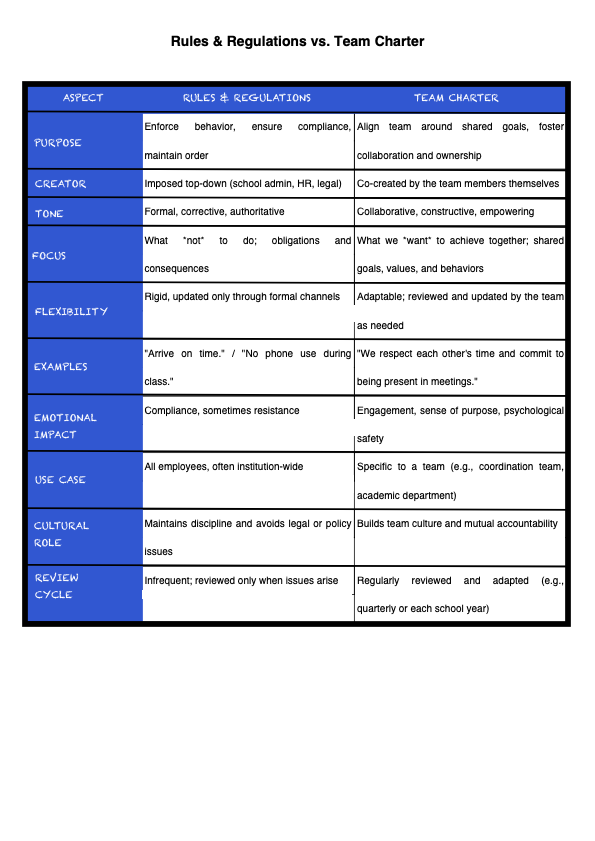
Rules and regulations are designed to enforce a minimum standard of behavior across the institution. They are often established by school administration or HR departments and apply to all employees equally. While necessary for legal and organizational consistency, they rarely address the specific challenges faced by language coordination teams, such as collaborative planning, curriculum alignment, or intercultural sensitivity.
Furthermore, rules are reactive-they exist to prevent problems, not to promote proactive collaboration or innovation. They often lack flexibility and do not evolve easily as the team’s context or goals change. In some cases, they can even undermine morale by focusing on punishment rather than growth.
What Is a Team Charter?
A Team Charter is a collaboratively developed document that outlines the purpose, values, roles, responsibilities, norms, and decision-making processes of a specific team. Unlike rules, which are imposed top-down, a Team Charter is co-created by the members of the team. This fosters a strong sense of ownership and engagement.
The goal of a Team Charter is not to control, but to align. It transforms a group of individuals into a team with a clear, shared purpose and a practical roadmap for how to work together effectively. It encourages honest conversations about expectations, accountability, and success-making it a powerful tool for teams that must navigate complexity, such as language departments.

Should every coordinator create a Team Charter with full teacher participation?
Not always. While the ideal team charter is co-created, the level of participation should depend on the coordinator’s leadership maturity, team dynamics, and institutional context.
When a collaborative Team Charter works well:
- The coordinator has clear leadership presence and is respected.
- Teachers are motivated, open to feedback, and team-oriented.
- There is already a culture of professionalism, even if informal.
- The institution encourages participatory leadership and values innovation.
In these cases, co-creating a charter can be a powerful way to:
- Build ownership.
- Improve team alignment.
- Prevent conflicts through shared norms.
When it may backfire or require a different approach:
You are right: inviting open input in an unprepared or conflictive team can lead to power struggles, confusion, or resentment. This might happen when:
- The team includes dominant personalities or toxic dynamics.
- The coordinator is new, insecure, or lacks credibility.
- Teachers view coordination as administrative, not leadership-oriented.
- There’s lack of institutional support or enforcement mechanisms.
In these cases, starting with clear rules and boundaries set by the coordinator is wiser. This allows the leader to establish authority and build trust before opening up participatory structures.
So… When should a coordinator use a Team Charter?
| Scenario | Approach |
|---|---|
| Healthy, respectful, aligned team | Co-create a team charter together |
| New or forming team | Coordinator drafts a basic charter, then opens selected areas for feedback |
| Team with low engagement or conflict | Coordinator sets rules first, builds culture gradually |
| Institutional policies dominate | Integrate mandatory policies, but co-create values and collaboration norms |
How can a coordinator identify the best approach?
Ask yourself:
- Do I have the leadership presence to hold the room?
→ If not, start with clear structures before collaboration. - Does my team act with professionalism when unsupervised?
→ If yes, invite participation. If no, delay it. - Is the team emotionally safe?
→ Unsafe teams use “participation” to vent, not to align. - Do I want feedback, or am I masking indecision?
→ Be honest. Don’t ask for input if you’re not ready to use it. - Am I using the charter to create clarity—or to avoid hard conversations?
→ A charter is a tool, not a substitute for leadership.
Recommended process for unsure coordinators:
- Draft the first version yourself, including:
- Mission
- Expectations
- Roles
- Norms
- Present it confidently, as the starting point—not a democratic brainstorm.
- Invite limited feedback only on certain parts (e.g. meeting times, communication channels).
- Reinforce and model the norms for at least one academic cycle.
- In a second stage, once the team is stable, you can co-review and revise the charter together.

Remember
A team charter is a leadership tool, not a democracy.
You use it when the team is ready to co-own the vision—and you are ready to lead the process.
It’s okay to start top-down and evolve into shared ownership.