

We can use the VERB TO BE in interrogative form for two reasons:
1. To confirm information. (When the answer is Yes or No)
2. To ask for new information (When the answer is something I don’t know yet).
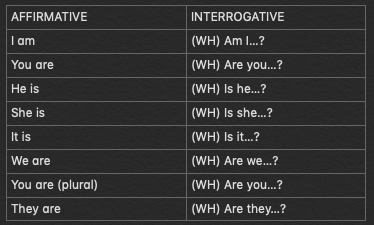
In both cases, the structure is inverted, the only difference is that we need to add a WH word* at the beginning when we want to ask for new information:
*WH Words:
Who (person)
What (thing)
When (time)
Where (place)
Why (reason)
Which (selection)
How … (description: how often, how far, how old, etc)
Am I late? (the answer could be ‘yes’ or ‘no’)
Are you Italian? (the answer could be ‘yes’ or ‘no’)
Are these your glasses? (the answer could be ‘yes’ or ‘no’)
When we confirm information, the short answers in formal language are:
Yes, I am / No, I ‘m not
Yes, he is / No, he isn’t / No, he’s not.
Yes, we are / No, we aren’t / No, we’re not.

In real language the answers are just ‘yes’ or ‘no’.