ABOUT THE COURSE AIMS
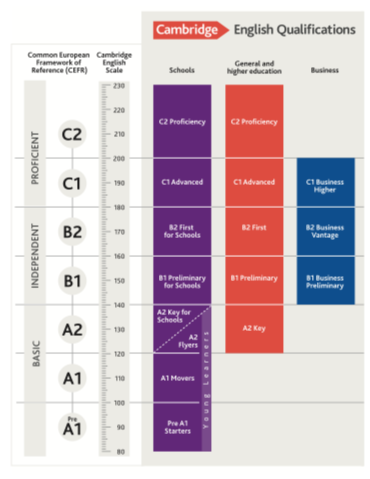
By the end of the courses, you will be asked to present an international examination to achieve the Cambridge Business English Certificate BEC.
Business Certificates were originally introduced in 1993 and feature three qualifications that provide a progressive way to develop English ability for international business and
the workplace:
- B1 Business Preliminary
- B2 Business Vantage
- C1 Business Higher
Business Certificates make it easy to prove to employers the exact level of a candidate’s English skills and are officially recognised by employers, universities and governments around the world.
Exam formats
Business Certificates can be taken as either paper-based or computer-based exams. We can also consider a different option called Cambridge Business Linguaskill.
Who are the exams for?
Business Certificates are typically taken by candidates preparing for a career in an international business or workplace environment, or to advance their present career.Candidates for B1 Business Preliminary want to show they can:
- read short messages
- interpret charts
- write short emails
- follow short telephone conversations and discussions
- talk about business-related matters.
Candidates for B2 Business Vantage want to show they can:
- write short pieces of business correspondence, reports or proposals
- read extracts from business publications
- listen to, understand and contribute to discussions in meetings.
Candidates for C1 Business Higher want to show they can:
- communicate effectively at managerial and professional level
- participate with confidence in workplace meetings and presentations
- express themselves with a high level of fluency
- react appropriately in different cultural and social situations.
If a candidate has not yet entered the job market, C1 Business Higher can be used to show universities and colleges that a candidate can:
- follow any academic business course at university level
- carry out complex and challenging research.

What level are the exams?
B1 Business Preliminary is set at Level B1. Achieving a certificate at this level proves that the candidate is able to communicate with native speakers for routine business and workplace purposes.
B2 Business Vantage is set at Level B2. A certificate at this level proves that the candidate is becoming skilled in Business English.
C1 Business Higher is targeted at Level C1 – the second-highest level on the CEFR scale. Level C1 is required in demanding professional settings, and achieving a certificate at this level proves that a candidate has reached a very advanced level of English. Exceptional candidates sometimes show ability beyond C1 level.
If a candidate achieves grade A in the exam, they will receive the Business English Certificate Higher stating that they demonstrated ability at Level C2.
Candidates at B1 level
Reading and Writing
CAN understand the general meaning of non-routine letters within own work area.
CAN understand most short reports of a predictable nature.
CAN make notes on routine matters, such as taking/placing orders.
CAN write straightforward, routine letters of a factual nature.
Listening and Speaking
CAN follow a simple presentation/demonstration.
CAN deal with predictable requests from a visitor.
CAN offer advice to clients within their own job area on simple matters. CAN state routine requirements (e.g. asking for typing to be done).
Candidates at B2 level
Reading and Writing
CAN understand the general meaning of non-routine letters.
CAN understand the general meaning of a report even if the topic isn’t predictable.
CAN write a simple report of a factual nature and begin to evaluate, advise, etc.
CAN write a non-routine letter where this is restricted to matters of fact.
Listening and Speaking
CAN ask for factual information and understand the answer.
CAN take and pass on most messages during a normal working day.
CAN express their own opinion, and present arguments to a limited extent.
CAN give a simple, prepared presentation on a familiar topic.
Candidates at C1 level
Reading and Writing
CAN understand correspondence expressed in non-standard language.
CAN deal with all routine requests for goods and services. CAN write most letters they are likely to be asked to.
CAN, within a reasonably short time, understand most reports that they are likely to come across.
Listening and Speaking
CAN contribute effectively to meetings and seminars within own area of work and argue for or against a case.
CAN follow a discussion with only occasional need for clarification.
CAN engage in an extended conversation with visitors on matters within her/his authority/competence.
HOW TO USE THIS PLATFORM.
You will find at the bottom some lessons that might be useful for you. Some resources will be handouts provided by your teacher to reinforce the information you saw during the lesson. There are some other lessons which are for you to practice your skills.
Every time you open a new lesson, you must click on VIEW THE LESSON QUIZ first.
After you finish your task, click on SAVE.
Click on COMPLETE to send the task for revision.

CONTACT INFORMATION
Dirección Académica
Dra. María Jossé Fernández
Tel. +33 7 79 1149 05
direccion.academica@aprendeid.com
WELCOME!